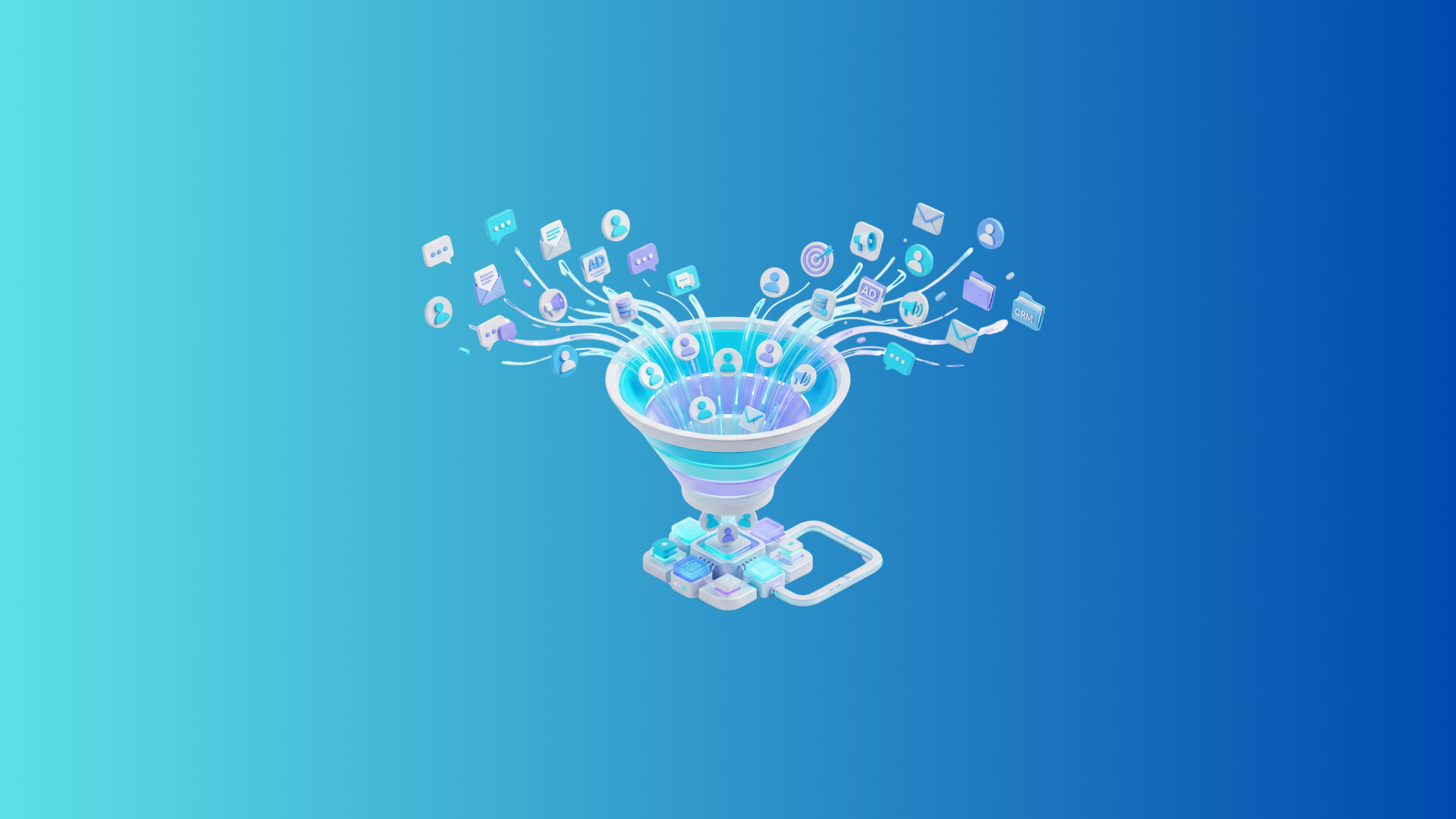
The sales funnel is a living system that either generates revenue or quietly drains your advertising budget. In this article, we break down each stage: what happens to the customer, what your team should do, and the most common mistakes that destroy sales at every step.
What is a sales funnel and why it matters
The term “sales funnel” was first introduced in 1898 by American advertising pioneer Elias St. Elmo Lewis, based on the AIDA model (Awareness, Interest, Desire, Action). Since then, the concept has evolved significantly, but its core remains the same: it represents the journey a person takes from first discovering your product to making a purchase—and, more importantly, to making repeat purchases.
Why is it called a “funnel”? Because at each stage, the number of people decreases. Hundreds or thousands may learn about your product, dozens may leave a request, and only a few become loyal customers. The goal of any business is to increase the percentage of people who move through each stage.
It’s important to understand that a sales funnel is a shared responsibility between marketing, sales, and customer service. If each department works in isolation without understanding what happens at other stages, the business will inevitably lose customers and revenue.
Overall funnel structure
Before diving into details, here’s a high-level overview of the funnel:
| Funnel Stage | Key Objective | Tools / Metrics |
|---|---|---|
| 1. Lead Generation | Attract potential customers | SEO, SMM, ads / Reach, clicks |
| 2. Qualification | Identify target buyers | CRM, scoring / BANT, MQL vs SQL |
| 3. Offer Development | Create a relevant value proposition | Case studies, demos, presentations / Demo CR |
| 4. Objection Handling | Address doubts and concerns | FAQ, reviews, guarantees / Sales cycle length |
| 5. Closing | Finalize the deal | CRM, e-signature / Win rate |
| 6. Retention & Loyalty | Turn into repeat customers | Email, loyalty programs / LTV, NPS |
Stage 1. Lead generation: how to attract potential customers
A lead is a person who has shown interest in your product or service in some way. They may have left their email on your website, sent a message via Instagram, called you, or simply subscribed to your newsletter. But before that happens, they first need to discover you.
Main lead generation channels
SEO and content marketing — a long-term investment: articles that rank in search engines can bring organic traffic for months or even years.
Paid advertising (PPC) — platforms like Google Ads, Meta Ads, and TikTok Ads. Results come quickly but depend on your budget.
SMM and social media — building awareness and engaging your audience through content.
Partnerships and referral programs — existing customers and partners recommend you to their audience.
Cold outreach — email campaigns and cold calls.
Events and networking — conferences, webinars, and exhibitions, especially effective in B2B.
The most common mistake at this stage
Businesses often focus on increasing the number of leads without analyzing their quality. One hundred unqualified leads will generate less revenue than ten well-qualified ones. That’s why the next stage is critical.
Stage 2. Lead qualification
Qualification is the process of determining whether a specific lead is actually a potential buyer. It sounds simple, but in practice, this is where most funnels break down.
There are several popular qualification frameworks. The most common in B2B is BANT:
- B (Budget): Does the person/company have the budget for your product?
- A (Authority): Is this person a decision-maker or just gathering information?
- N (Need): Is there a real need for your product or service?
- T (Timeline): When is the purchase decision expected?
MQL vs SQL: what’s the difference?
Not everyone who shows interest in your product is ready to buy. And not everyone who is ready to buy still needs nurturing. That’s why marketing distinguishes between two types of leads: MQL and SQL.
| Criteria | MQL (Marketing Qualified Lead) | SQL (Sales Qualified Lead) |
|---|---|---|
| Budget | Unknown | Confirmed |
| Urgency | None / unclear | Clear decision timeline |
| Engagement | Downloaded content, reads blog | Requested demo, submitted inquiry |
| Next step | Nurturing (email, content) | Handoff to sales manager |
The difference is not in the value of the lead, but in their readiness. MQLs need time and content. SQLs need a conversation. The better your team understands this distinction, the less effort is wasted.
Stage 3. Offer development
The lead is qualified. They are potentially ready to buy. Now your task is to convince them that your product is the best solution to their problem.
At this stage, it’s critical to shift from product features to the value for the specific customer.
What makes an effective offer
- Personalization: an offer that speaks the customer’s language and reflects their specific pain points
- Social proof: case studies, reviews, client logos, ratings on independent platforms
- Clear USP: why you over competitors
- Demo or trial: let the customer experience the product before buying
- Transparent pricing and terms: surprises at the invoicing stage kill deals
Stage 4. Objection handling
A customer who raises objections is a customer who needs more information or reassurance.
Most common objections in sales
- Price: “It’s too expensive”, “Competitors are cheaper”
- Timing: “Not the right time”, “Let’s revisit next quarter”
- Trust: “We’re not familiar with your company”, “Show us case studies”
- Need: “We don’t need this”, “We’re managing without it”
- Authority: “I need approval from a manager/partner”
Effective ways to handle objections
- Never argue with the customer — it’s a losing strategy
- Acknowledge the concern: “I understand your concern, that’s important”
- Ask clarifying questions: “What exactly is holding you back right now?”
- Provide proof: case study, testimonial, money-back guarantee
- Reframe value: shift the conversation from price to ROI
- Give time, but always follow up
Stage 5. Closing the deal
Closing is the final step where the customer has received all answers and is ready to move forward.
There are many closing techniques, but the most effective one is simple:
“Are you ready to take the next step?” or “When would it be convenient for you to sign the agreement?”
A clear call to action removes uncertainty and speeds up decision-making.
Common mistakes at the final stage
- Delays in sending proposals: every hour reduces your chances of success
- No clear deadlines: “Valid until [date]” works better than open-ended offers
- Ignoring bureaucracy: ensure contracts, invoices, and terms are ready in advance
Stage 6. Retention and loyalty
Customer retention tools
- Onboarding: a well-structured start reduces early churn
- Email marketing and personalized offers: regular communication that provides value, not just sells
- Loyalty programs: reward points, repeat purchase discounts, referral bonuses
- Customer Success: a dedicated manager/team helping customers achieve results
- NPS surveys: measure loyalty and address dissatisfaction early
- Upsell and cross-sell: satisfied customers are more likely to expand cooperation when the timing is right
Key sales funnel metrics: what to track and why
Let’s look at the key metrics you should track at each stage:
- Leads Generated: the total number of potential customers entering your funnel
- Lead Qualification Rate: the percentage of leads that become SQLs
- Stage Conversion Rate: how many leads move from one stage to the next
- Sales Cycle Length: the number of days from first contact to deal closing
- Win Rate: the percentage of successfully closed deals
- Customer Lifetime Value (LTV): total revenue generated from a customer over time
- Churn Rate: the percentage of customers who stop using your product or service
- Net Promoter Score (NPS): a measure of customer loyalty and willingness to recommend
Tracking these metrics in real time helps you quickly identify bottlenecks in your funnel and fix them before they become critical.
5 common sales funnel mistakes and how to avoid them
Mistake 1: Focusing on quantity over quality
More leads doesn’t always mean better results.
100 unqualified leads = 100 wasted calls.
Invest in well-targeted advertising and a clearly defined ICP (Ideal Customer Profile).
Mistake 2: No follow-up system
Most deals don’t close after the first interaction. Without a structured follow-up process, potential customers simply move on—and bringing them back becomes much harder.
Mistake 3: Misalignment between marketing and sales
“Marketing brings плохие leads” vs “Sales can’t close deals” — a classic conflict.
Solution: clearly defined MQL/SQL criteria and регулярні meetings between teams.
Mistake 4: Ignoring post-sale experience
The sale doesn’t end with signing the contract. Poor onboarding and lack of support lead directly to churn and negative reviews.
Mistake 5: Lack of analytics and testing
Without регулярний review of metrics and A/B testing, your funnel quickly becomes outdated. The market evolves—and your funnel must evolve with it.
FAQ
What’s the difference between a sales funnel and a marketing funnel?
A marketing funnel covers the journey from first brand awareness to purchase readiness.
A sales funnel picks up from there—turning ready-to-buy leads into customers and retaining them.
Modern approaches combine both into a unified customer journey.
Is a sales funnel suitable for small businesses?
Absolutely. Even a small business without a dedicated marketing team can build a simple three-stage funnel: attraction → consultation → sale.
The key is understanding where customers drop off and fixing those points.
How often should you review your funnel?
A full funnel audit is recommended at least once per quarter.
You should also review it after major changes: launching a new product, changing your target audience, shifts in the competitive landscape, or a sudden drop in conversion.
How to make sure no customer inquiries are lost?
When customers message via chat, call, and send emails at the same time, some inquiries inevitably get lost without a unified system.
Tools like NovaTalks bring all communication channels into one place, ensuring every inquiry is handled on time at any stage of the funnel.
Can a sales funnel be automated?
Yes—and it should be. Automating lead nurturing (email sequences, chatbots), reminders for managers, and reporting significantly reduces manual work and shortens the sales cycle.
However, automation should enhance human interaction—not replace it where it matters most.
Conclusion: a funnel is a living system
A sales funnel is an ongoing process. Markets change, customers become more demanding, and competitors continuously improve their strategies.
The key takeaways:
- Each stage of the funnel is a separate responsibility area with its own metrics and tools
- Marketing and sales must operate as one system, not separate silos
- Analytics and regular audits are essential for performance
- Technology (automation, AI tools) is a growth driver
If you want your sales funnel to become a real business asset, start with an audit.
Find the weakest stage and fix it. Then move to the next one.
That’s how systems that actually sell are built.