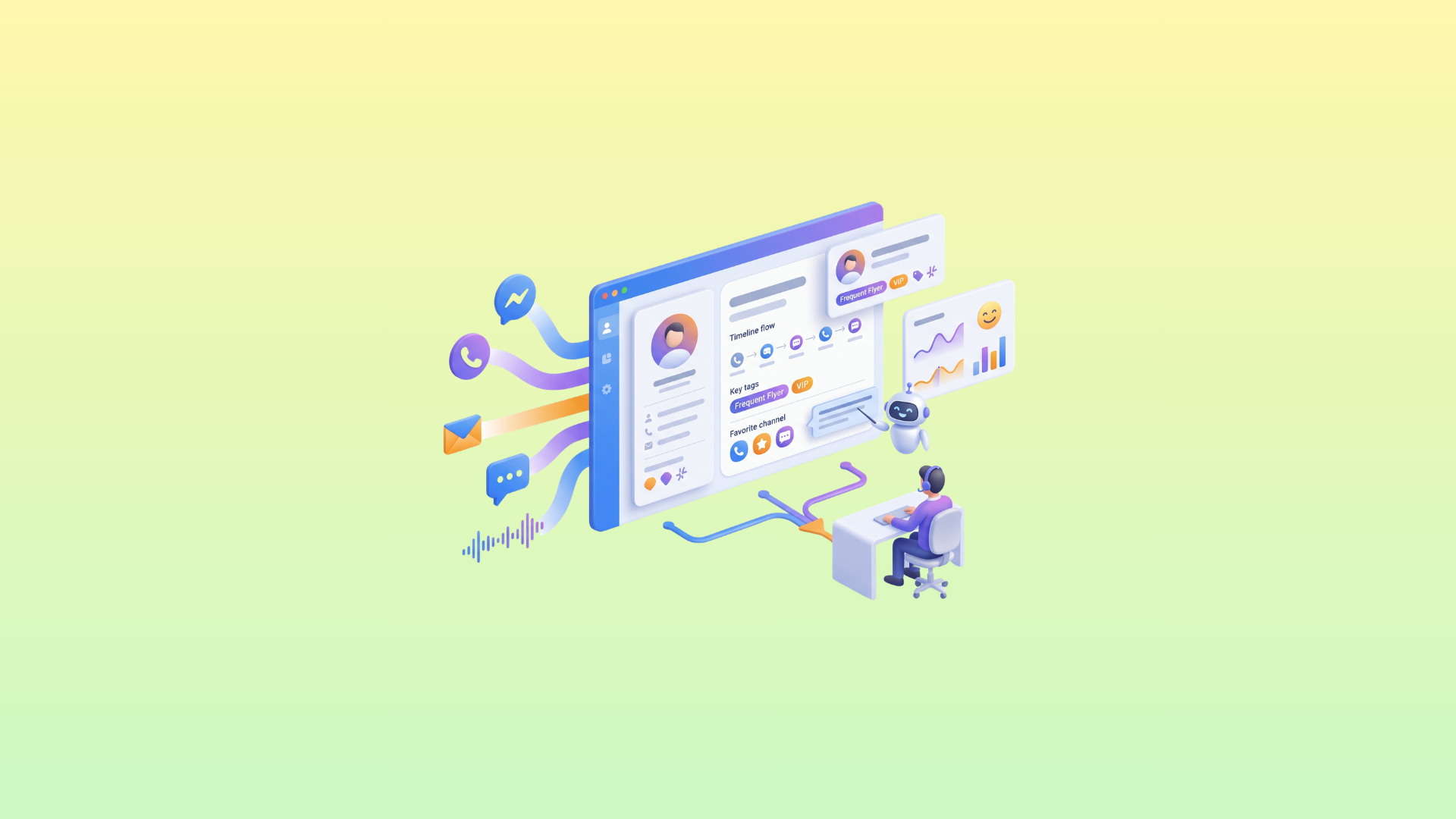
Today’s customer does not want to explain the same issue three times to different agents. They expect to be recognized, remembered, and understood — even before they introduce themselves. That is why personalization in a contact center has become an operational necessity for any business that wants to build long-term customer relationships.
In this article, we look at the key personalization tools: how they work, where they are used, and what value they bring to businesses in practice.
Key Takeaways: Contact Center Personalization Tools Overview
For those who want a quick overview:
| Tool | How it works | Business value |
|---|---|---|
| Omnichannel platform | Combines all channels — Viber, Telegram, WhatsApp, calls, chat, and email — in one interface. The agent sees the customer’s full history before the conversation begins. | Faster service, fewer repeated questions, and a seamless customer experience. |
| Smart routing | Directs the customer not to the first available agent, but to the most suitable one based on topic, language, skills, or qualification. | Higher First Contact Resolution and fewer transfers between agents. |
| AI chatbots | Handle typical requests 24/7 and transfer complex issues to a live agent together with the full conversation context. | Reduced workload for agents and faster responses for customers. |
| AI agent assistant | Suggests answers in real time, corrects mistakes, translates messages, adjusts tone, and generates conversation summaries. | Better agent productivity and more consistent communication quality. |
| Automated quality assessment | Analyzes 100% of conversations, including customer emotions, script compliance, and agent performance. | Full visibility into service quality and faster detection of problem areas. |
| Personalized bulk messaging | Sends individual messages through messengers and social networks using tags, filters, and automated triggers. | More relevant communication and higher customer engagement. |
What Is Personalization in a Contact Center and Why Does Business Need It?
Personalization is the ability of a system to recognize each customer as a unique individual and adapt communication based on their history, preferences, and current context. Simply put, the customer does not have to explain who they are and what they need every time — the system already knows.
A personalized approach makes it possible to:
- address the customer by name and take their previous experience into account;
- avoid repeated questions they have already answered before;
- suggest a solution even before the problem has been clearly formulated;
- select the most suitable agent or channel for a specific situation.
The difference between “How can I help you?” and “Hello, Oleksii! Were you able to resolve the issue you contacted us about yesterday?” is enormous. This is the essence of personalized customer service.
To learn more about how personalization builds long-term loyalty and why customers return not because of discounts, but because of trust, read our related article.
Omnichannel Platform: A Single Customer Context Across All Communication Channels
A customer writes in chat, then calls, and later contacts the company via Viber. If these channels are not connected, each agent will treat the customer as new and unfamiliar. An omnichannel platform solves this problem.
It is important to distinguish between two concepts:
Multichannel communication means the customer can contact the company through different channels, but each channel operates separately.
Omnichannel communication means all channels are connected: the customer may start in chat, continue by phone, and the agent still has the full context.
What an omnichannel platform provides in practice:
- a single customer profile regardless of the communication channel;
- preserved context when switching between channels;
- access to the full customer history before the conversation begins;
- unified analytics across all contact points.
NovaTalks is an omnichannel customer support platform that brings together messengers such as Viber, Telegram, WhatsApp, Instagram, as well as calls, live chat, and email in a single interface. Customer data, tags, and the complete interaction history are stored centrally, allowing the agent to see everything they need before the conversation starts.
Smart Queue: Intelligent Call Routing in the Contact Center
A smart queue is an intelligent routing mechanism that directs the customer not to the first available agent, but to the one best suited to resolve their specific issue.
The system takes into account:
- the topic of the request — technical support, sales, complaints;
- the communication language and customer priority;
- current agent workload and qualifications;
- previous interaction history with a specific agent.
The result is fewer transfers between agents and a higher FCR — First Contact Resolution. The customer receives an answer from someone who truly understands their issue from the very first interaction.
NovaTalks allows flexible routing of chats and calls between agents based on their workload and qualifications.
AI Chatbots and Agent Assistant: Personalized Customer Support 24/7
Modern AI chatbots conduct natural conversations, understand context, and transfer customers to live agents with the full conversation history — without forcing the customer to repeat themselves.
What distinguishes a new-generation AI bot from a traditional one:
NLU, or Natural Language Understanding. The bot understands meaning rather than simply searching for keywords. For example, “I want to return an item” and “How can I send back my purchase?” are treated as the same intent.
Awareness of previous interactions during the current session.
Smooth transfer to a live agent with the full conversation context.
Continuous learning from real conversations.
NovaTalks provides two levels of AI support:
Chatbots. A builder for creating multilingual bots for every channel. They operate 24/7, reduce agent workload, and smoothly transfer customers to live agents with the full conversation context.
AI agent assistant. This tool supports agents in real time: it corrects mistakes, suggests translations, adjusts the tone of replies, and automatically generates conversation summaries — all within one interface.
Personalized Bulk Messaging: Individual Communication at Scale
Personalization also means being able to contact the customer first — at the right moment and with the right message.
NovaTalks supports automated bulk messaging in messengers and social networks:
- audience filtering by tags, attributes, and contact details;
- personalized offers, reminders, and promotions for each customer;
- automatic triggers that launch messaging campaigns based on a specific event or condition.
Messages are delivered where the customer already is — in messengers and social networks. This ensures that important information does not go unnoticed.
AI Analytics and Automated Quality Assessment: Monitoring 100% of Conversations
Traditional quality control is based on selective review of call recordings. A manager can physically check only around 5% of conversations. Everything else remains outside their field of attention.
NovaTalks AI tools change this approach:
- automated quality assessment analyzes 100% of conversations — both text and voice;
- the system evaluates customer emotions, agent compliance with scripts, and the effectiveness of each interaction;
- managers get a complete picture and can focus only on conversations that require attention.
NovaTalks Insights automatically processes all customer interactions and metadata, identifying key patterns so you can understand where the problems are and where the growth opportunities lie.
Flexible reporting with BI dashboards allows businesses to track contact center performance, agent productivity, and customer satisfaction scores — CSAT — in real time.
Comparison of Contact Center Personalization Tools: What to Choose
Below is a summarized overview of the main tools, their functions, and their practical impact.
| Tool | What it does | Customer benefit | Business benefit |
|---|---|---|---|
| Omnichannel platform | Combines all channels in one interface. | The customer does not have to repeat their issue every time. | Unified analytics and full context of all interactions. |
| Smart queue | Routes the customer to the most suitable agent. | The issue is resolved on the first contact. | Higher FCR and fewer transfers. |
| AI chatbot | Handles typical requests 24/7. | Instant response without waiting in a queue. | Reduced workload for agents. |
| AI agent assistant | Suggests replies, translates messages, and generates summaries. | Higher-quality responses from agents. | Shorter handling time for customer requests. |
| Automated quality assessment | Analyzes 100% of conversations. | Consistently high-quality service. | Full visibility into performance without manual review. |
| Bulk messaging | Sends personalized messages through messengers. | Relevant offers and reminders. | Higher open and response rates. |
How to Implement Personalization in a Contact Center: A Step-by-Step Approach
Step 1. Audit Your Data and Current Tools
Understand what customer data you already have, where it is stored, and how it is used. In many cases, a company already has enough information — it is simply scattered across different systems without proper integration.
Step 2. Define Priority Touchpoints
Start with the most painful areas: verification, the first greeting, and transfers between agents. Do not try to personalize everything at once.
Step 3. Integrate Channels into a Single Ecosystem
Personalization is impossible without uniting all communication channels and analytics tools. Fragmented data is the main enemy of personalization.
Step 4. Train the Team and Measure Results
Agents must know how to read system prompts and use customer context for natural communication. Track FCR, CSAT, AHT, and NPS — personalization should improve these metrics.
Common Mistakes When Implementing Personalization in a Contact Center
Personalization for the Sake of Personalization
Addressing the customer by name ten times during one conversation is manipulation, not personalization. Customers easily sense insincerity and distance themselves from companies that try to appear “close” using purely technical methods.
Ignoring Personal Data Protection and GDPR
Customers want to be understood, but they do not want to feel as if they are “under a microscope.” Clear GDPR compliance and transparency in data collection are necessary conditions for maintaining trust.
Technology Without Strategy
Buying an expensive AI tool without understanding what specific problem it solves is a classic and costly mistake. First comes the business objective, then the technology.
Fragmented Data
If customer information is scattered across several systems without integration, even the best tool will not create a complete picture. The quality of personalization always depends on the quality of the source data.
FAQ: Frequently Asked Questions About Personalization Tools in Contact Centers
Can personalization be implemented in a small contact center?
Yes. Even a basic omnichannel platform that preserves the context of customer interactions can deliver a noticeable result. NovaTalks allows businesses to start with a minimal configuration and add new tools as the team grows.
What is the difference between omnichannel and multichannel communication?
Multichannel communication means that the customer can contact the company through several channels, but each channel operates separately. Omnichannel communication means that all channels are connected: the customer may start in chat, continue by phone, and the agent still has the full context.
Will an AI chatbot replace contact center agents?
Not completely, but it will transform their roles. AI handles routine requests, freeing agents to focus on emotionally complex and non-standard conversations — situations where the human factor remains irreplaceable.
What is FCR and how does personalization affect it?
FCR, or First Contact Resolution, is the rate at which customer issues are resolved during the first interaction. An agent with full customer context can solve issues faster and more accurately, which directly increases FCR and reduces the number of repeat calls.
What is CSAT and why should it be measured?
CSAT, or Customer Satisfaction Score, measures how satisfied a customer is after an interaction. It is usually based on a short question such as: “How satisfied are you with the service?” Personalization directly improves this score because the customer feels that they were treated attentively and individually.
How can customer personal data be protected when implementing personalization?
By using data encryption, role-based access control, activity logging, and transparent data processing terms in accordance with GDPR. Customers should always know what data is collected and for what purpose.
Conclusion
Personalization in a contact center is a systematic response to a fundamental customer need: to be heard, recognized, and served without unnecessary effort on their part.
Companies that invest in a personalized approach gain a competitive advantage that is difficult to copy: customers who return not because of discounts, but because of trust. NovaTalks helps build this ecosystem with all communication channels, AI tools, and analytics in one platform.
Ready for personalized service? Start with NovaTalks.