Why Customer Support Is Your Investment
Customer support is often seen by companies as a cost center to optimize or reduce. However, it is actually one of the key drivers of trust, loyalty, and business profitability.
Customer support is where the emotional perception of a brand is formed. Every customer interaction is a moment when someone entrusts the company with their time, their problem, and often their frustration. How the company responds in that moment shapes the customer’s emotional connection to the brand.
Research across industries consistently shows that even a small increase in customer retention can significantly impact a company’s profits—and this effect grows as the business scales.
A customer who receives quick, human-centered help is highly likely to stay and recommend you to others. One who is ignored or sent to read a 40-page FAQ will leave and may never return.
Five Pillars of a Strong Support System
There is no magic button that instantly boosts loyalty. It’s a system built on several interconnected elements:
- Accessibility: Customers can easily find where and how to get help, anytime.
- Speed: Responses come before frustration sets in.
- Competence: The team knows the product and provides clear, accurate answers.
- Empathy: Support recognizes that there’s a real person behind every request.
- First-contact resolution: Issues are solved in a single interaction, without transfers or delays.
These elements are not hierarchical—they are equally important. Fast responses without competence only frustrate customers faster. Deep knowledge without empathy turns communication into a cold reference service.
Omnichannel Support: Being Where Your Customer Is
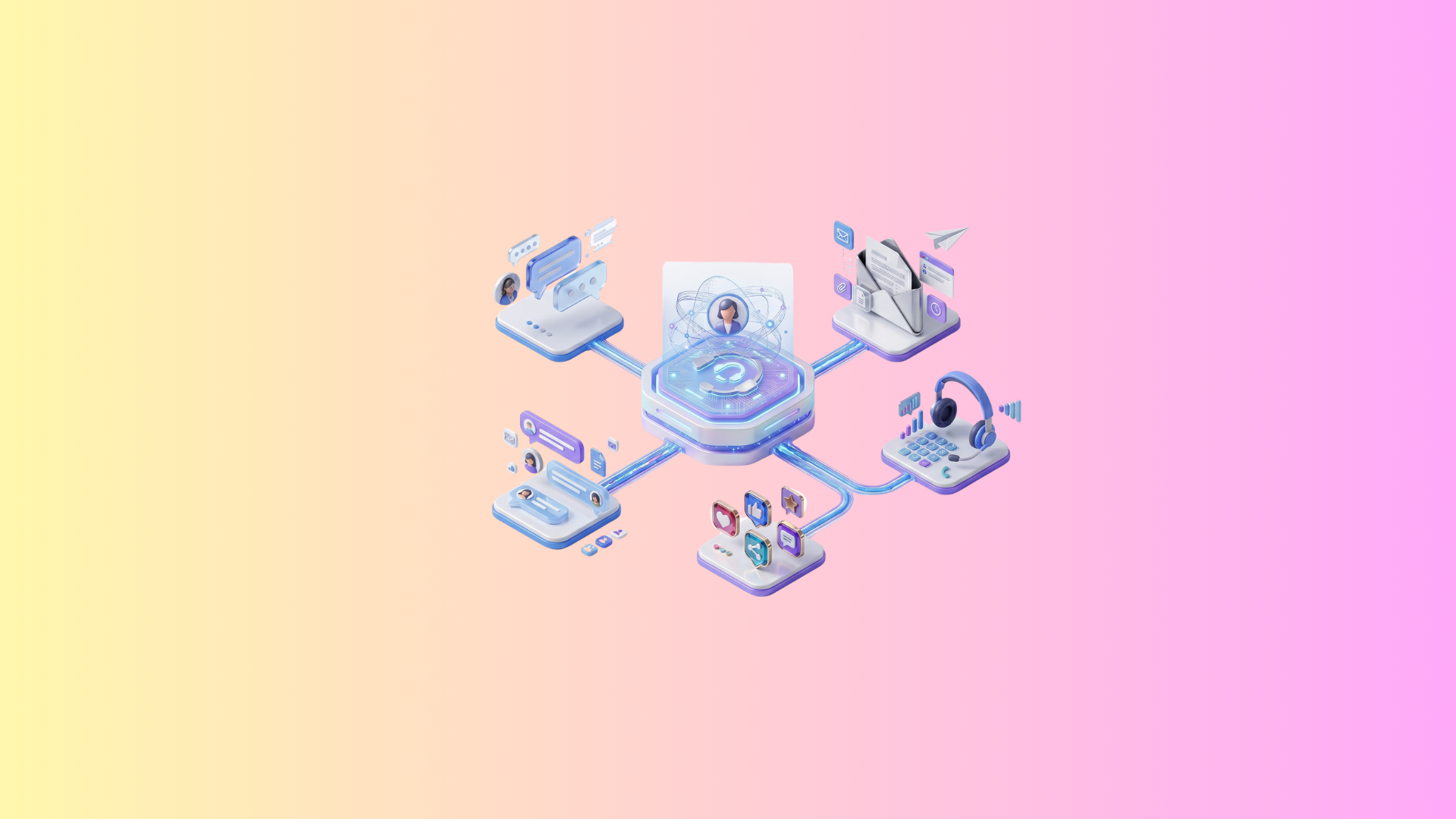
Modern customers don’t think in terms of “phone” or “email.” They reach out wherever it’s most convenient at the moment. That’s why modern customer support must be omnichannel and maintain a unified interaction context.
| Channel | Advantages | Limitations | Best for | Complexity |
|---|---|---|---|---|
| Live chat (website) | Instant response, proactive engagement | Requires online agents or chatbots | E-commerce, SaaS | Medium |
| Documented communication, good for complex issues | Slower response time | B2B, technical support | Low | |
| Messaging apps (Telegram, Viber) | Familiar environment, push notifications | Harder to integrate with CRM | Retail, services | Medium |
| Phone | Highest level of personalization | Hardest to scale | Premium segment, crisis situations | High |
| Social media | Public responses showcase service quality | High-pressure, fast-paced environment | B2C brands | High |
| Knowledge base / FAQ | Reduces team workload 24/7 | Requires customer initiative | All business types | Low |
The key condition for omnichannel support is a single, unified context. Customers should not have to repeat their issue every time they switch from one channel to another.
Response Speed vs. Quality
Businesses often fall into a trap: either they try to respond instantly, sacrificing quality, or they take too long crafting a perfect reply that the customer is no longer waiting for. Here are some general benchmarks:
- Live chat – expected response within 1 minute, maximum 3 minutes (critical)
- Phone – wait time up to 20 seconds, maximum 2 minutes (critical)
- Social media – up to 1 hour, maximum 4 hours (high priority)
- Messaging apps – up to 30 minutes, maximum 2 hours (high priority)
- Email – 2–4 hours, maximum 24 hours (standard priority)
The key rule: it’s better to acknowledge a request within a minute and resolve it within an hour than to stay silent for three hours and deliver a perfect answer. A customer in uncertainty is a stressed customer.
The People Behind Support: Training and Motivation
A support system is, first and foremost, about people. Even the best CRM cannot replace a skilled professional who can truly listen to customers and handle нестандартні ситуації.
What a great support specialist should be able to do:
- Have deep knowledge of the product or service
- Listen without interrupting and rephrase the issue to confirm understanding
- Stay calm in conflict situations and avoid becoming defensive
- See the human need behind a technical request
- Take ownership instead of saying “this is not my department”
- Capture feedback and pass it to the product or quality team
Loyalty Metrics: What to Measure and How
What isn’t measured can’t be improved. At the same time, it’s important not to drown in numbers—focus on metrics that truly reflect the customer experience:
- NPS (Net Promoter Score): measures willingness to recommend the company (promoters vs. detractors)
- CSAT (Customer Satisfaction Score): satisfaction with a specific interaction after ticket closure
- FCR (First Contact Resolution): percentage of issues resolved on the first interaction
- ART (Average Response Time): average time to the first reply (depends on the channel)
- Churn Rate: percentage of customers who stop using your service over a given period
- CES (Customer Effort Score): how easy it is for customers to get help (measured on a 1–7 scale)
In practice, customer support directly determines how these metrics perform.
Common Mistakes That Destroy Customer Trust
Even companies with good intentions make mistakes that systematically undermine loyalty:
| Mistake | How it feels to the customer | How to fix it |
|---|---|---|
| Passing between departments | “You’ll be transferred…” — and starting over again | Assign a single case owner, transfer context internally |
| Template replies without substance | Customer gets a “Thank you” instead of a solution | Personalize responses, avoid copy-paste without adaptation |
| Ignoring negative feedback | Complaints remain unanswered in public | Assign responsibility for monitoring and responding |
| Overpromising and underdelivering | “We’ll get back to you today” — then silence | Set realistic SLAs, use automated reminders |
| Defending the company instead of solving | The agent argues instead of helping | Provide conflict management training, empower agents to apologize |
NovaTalks: Everything a Contact Center Needs in One Interface
Most contact centers look the same: five browser tabs open, agents switching between Telegram, email, and telephony, asking customers to repeat information they’ve already shared, while managers review reports at the end of the month trying to figure out where quality actually dropped. NovaTalks solves this comprehensively.
- All channels in one place: Telegram, Viber, Instagram, email, telephony—agents see the full customer history regardless of the channel
- No-code chatbots: multi-language support, 24/7 availability, with seamless handoff to human agents when needed
- AI assistant in real time: fixes grammar, adjusts tone, translates, and summarizes conversations instantly
- Personalized mass messaging: audience segmentation, triggers, support for messengers and social media—communication becomes structured, not chaotic
- Analytics that answers questions: built-in dashboards, CSAT tracking, agent performance, and text analytics via NovaTalks Insights
- Scalable for any size: from small teams to large contact centers, adaptable to specific business processes
Request a demo — and we’ll show you how the platform can solve your business challenges.
FAQ: Answers to Frequently Asked Questions
Can a chatbot fully replace a human support specialist?
No. Chatbots are effective at handling standard requests such as order status, returns, or pricing. However, emotionally sensitive situations, complex cases, and VIP customers require human interaction.
The best customer experience comes from combining automation with human support. The optimal model is: the bot filters and routes requests, while a human handles complex issues.
Which metric is the most important for measuring support quality?
It depends on your goals:
- Long-term loyalty: NPS and Churn Rate
- Quality of a specific interaction: CSAT and FCR
- Customer effort: CES
The best approach is to track 2–3 metrics together rather than focusing on a single number.
Is NovaTalks suitable for small businesses, or only for large contact centers?
NovaTalks scales to fit teams of any size—from a few agents to large contact centers. The platform easily adapts to current business needs and can grow alongside the company.
Small businesses get access to the same tools:
- a unified interface for all communication channels
- chatbots
- analytics
all without the need to build complex infrastructure from the start.