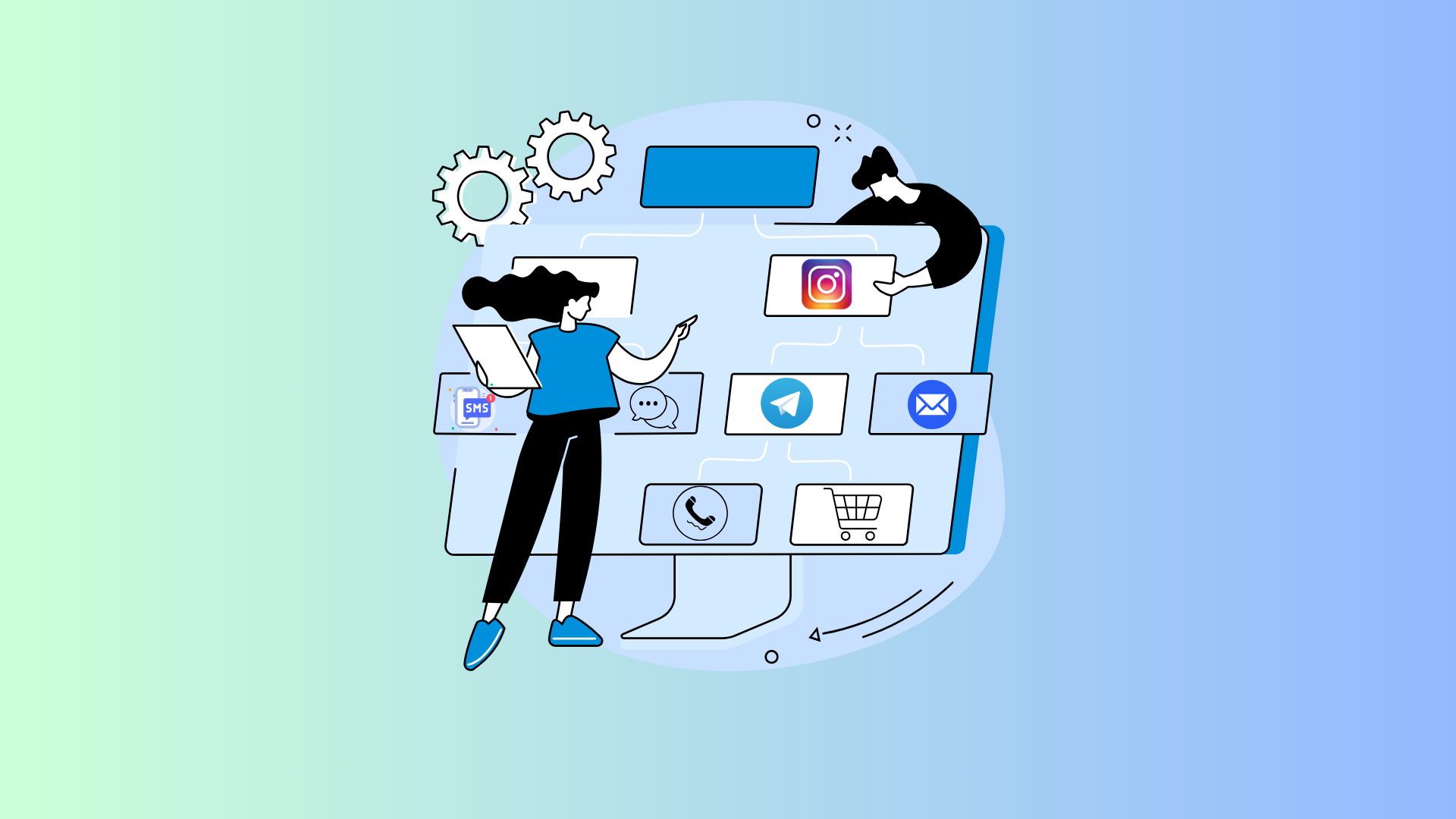
In recent years, the market has changed significantly. If earlier a business could rely on one or two communication channels with customers, today this is a direct path to losing competitiveness. Consumers have become more demanding: they expect to be able to contact a company anywhere and anytime through the channel most convenient for them.
Numerous studies confirm that companies that skillfully use multiple sales channels demonstrate significantly higher conversion and customer retention rates. But there is an important nuance: it is not enough just to open profiles on all possible social networks and messengers. Chaotic addition of channels without a clear strategy often leads to the opposite effect: service quality drops, inquiries get lost, and customers receive conflicting information.
The issue is not in the number of channels, but in choosing the right ones and ensuring they work harmoniously. Let’s look at how to build an effective system of sales channels that increases conversions and makes life easier for your team.
What sales channels are and why they matter
Sales channels are all possible ways your business interacts with customers to make a sale. It can be anything: from a regular phone call to a complex funnel in a messenger with a chatbot.
Why is this so important? Imagine that you opened a coffee shop, but the door only works from 2 p.m. to 3 p.m. Absurd, right? Yet this is exactly how a business operates when it limits itself to one or two sales channels. You simply are not where your customers are.
The modern buyer does not want to adapt to your rules. They are used to brands adapting to them. Some prefer to call, others find it more convenient to write on Telegram at three in the morning, and some won’t buy at all until they talk to a real person via video call.
Main types of sales channels
Let’s take a look at what channels exist and what each is best suited for.
Social media (Instagram, Facebook, TikTok) – have become full-fledged marketplaces. People not only browse content there but also buy directly in the app. Works especially well for visual products: clothing, accessories, cosmetics, food. The main advantage is the ability to show the product in action and create an emotional connection with the brand.
Messengers (Viber, Telegram, WhatsApp) – the golden middle between formality and convenience. Here the customer can write at any time, and you respond when convenient. Plus, the conversation history is always available. Ideal for consultations, quick questions, and promotion reminders.
Email – the good old classic, which some mistakenly consider outdated. In fact, email works perfectly for the B2B sector, where you need to send a commercial offer, invoice, or detailed specification. It is also indispensable for long sales cycles.
Phone calls – it may seem that in the digital age the phone has lost relevance. But for complex products, expensive purchases, or conflict resolution, voice contact is irreplaceable. A real voice creates trust that is hard to achieve through messaging.
Online chat on the website – the first step to purchase for those who are already on your site. If someone is browsing product pages but hesitates, a quick response in the chat can be the push they need to complete the order.
SMS – short, clear, without fluff. Ideal for order confirmations, appointment reminders, or urgent promotions. The main thing is not to overdo it with quantity, because people quickly get tired of spam.
Marketplaces (Rozetka, Prom, Amazon) – a ready-made audience on a plate. You don’t need to invest in advertising and attract traffic — people are already there. But there is a nuance: high competition and platform fees take part of the profit.
How to choose the right channels for your business
There is no universal formula “take three channels and you’ll be happy.” Everything depends on the specifics of your business. Here’s what to pay attention to.
Who your audience is
If you sell gadgets for young people, relying on email and waiting for orders is a losing strategy. Your audience is on TikTok and Instagram. But if you supply industrial equipment to factories, the purchasing director will hardly look for a machine in stories.
Do a simple exercise: ask your current customers. Where did they find you? How would they prefer to communicate with you? The answers may surprise you.
What you sell
Complex technical solutions require detailed consultations — you’ll need telephony, video calls, maybe in-person meetings. Simple consumer goods sell perfectly through messengers and social media.
Expensive purchases (real estate, cars, premium services) require a long trust-building cycle. Here a combination works: email newsletters for warming up + phone calls to close the deal.
How many resources you have
Dreams and reality differ. You may want to be everywhere, but if you have two managers who are already overwhelmed, adding a fifth channel is a path to lower service quality across all channels.
It’s better to work excellently in three channels than mediocrely in seven. A customer who wrote to you and didn’t receive a response for five hours is unlikely to return.
Where your competitors are
This doesn’t mean you should blindly copy them. But if all players in your niche are active on Telegram and you are not, you lose part of the market. At the same time, if you find a channel where competitors are absent but your audience is present — congratulations, you found a gold mine.
Why simply having many channels is not the solution
This is the main trap most businesses fall into. They think: I’ll add Instagram, Telegram, Viber, the website, telephony — and problem solved. And then the real chaos begins.
A customer writes on Instagram, doesn’t get a quick response, and calls the phone. The manager there doesn’t even know about the previous message and starts over. The customer is irritated, the manager wastes double the time, and everything falls apart.
Or another scenario: you have five different chats with the same customer across different channels. The history is fragmented, nobody understands what was promised. Sound familiar?
Today’s business needs not just multiple channels but their synchronized work. That’s why omnichannel solutions can significantly improve customer interactions, ensuring a seamless experience across platforms and building trust in the brand.
Key benefits of multichannel solutions
First, you don’t lose inquiries. All messages go into the system and are automatically distributed among managers.
Second, analytics and statistics. You see which channels bring the most sales, where the highest conversion is, and where customers “get stuck” the longest. This allows you to allocate budget and efforts where they work best.
Third, automation of routine tasks. Chatbots answer typical questions 24/7, automated messages remind customers about unfinished orders, and the system assigns the appropriate manager depending on the inquiry type.
Fourth, scalability. When the business grows, adding a new manager to the system takes just a few minutes. Training is also faster because everything is in one place, with no need to learn five different apps.
Integration with multichannel marketing
Sales channels do not exist in a vacuum. They are closely linked to marketing activities. You launched an Instagram ad, the customer saw it, visited your website, added an item to the cart but didn’t complete the purchase. What’s next?
An effective strategy implies integration with multichannel marketing: the system sees that the customer is interested and automatically triggers a sequence of actions. It can send an email with a discount code, remind about the product via SMS, or show retargeting ads.
Multichannel marketing is when you use several communication channels for promotion, and all of them work synchronously. The customer sees your offer in different places but receives a consistent brand impression, not fragmented messages.
For example, a person subscribes to your newsletter — that’s one contact. Then they see your ad on Facebook — the second contact. They visit your website and chat with a bot — the third contact. And now they are ready to buy because you gently and consistently reminded them about yourself through different channels. This synergy gives the best results.
How NovaTalks helps unify sales channels
When you face the problem of scattered channels, sooner or later you realize: you need a single control center. This is exactly what NovaTalks offers — a platform that gathers all communication channels in one place.
Imagine: a manager sits in one interface and sees all inquiries — from Instagram, Telegram, Viber, email, phone calls, and the online chat on the site. They don’t switch between tabs, don’t forget to respond because everything is visible.
The platform stores the full interaction history with each customer. No matter how many times they contacted you or through which channels, all information is in one card. This saves a huge amount of time and improves service quality.
NovaTalks supports integration with all popular messengers, letting customers choose their preferred method of communication. For the business, this means no inquiries get lost in the chaos.
Telephony is also integrated. Calls are recorded, the manager can add notes after the conversation, and everything is linked to the customer card. Next time they call or write, the manager instantly sees the context.
There’s also the option to configure chatbots for automatic replies. This allows even small businesses to be available 24/7. The bot answers typical questions, gathers initial information, and forwards complex inquiries to a live manager.
The analytics system shows which channel brings the most conversions, where customers drop off, and how much time it takes on average to process an inquiry. Based on this data, processes can be optimized and resources reallocated.
For managers, there are convenient dashboards with key metrics: number of processed inquiries, response speed, customer satisfaction, workload on managers. Everything is clear, without digging through reports.
And the most interesting part — the AI system for automatic quality evaluation of dialogs. Artificial intelligence analyzes conversations, provides scores, and identifies weak points.
Choosing sales channels is an ongoing process of adaptation. What works for your competitor may not work for you. What is effective today may become outdated tomorrow.
The main thing is to stay flexible, listen to your customers, and not be afraid to experiment. Start small, but do it well. Invest in solutions that allow you to grow.
The world is changing fast, but one thing remains constant: people buy from those they trust and those who make their lives easier. The right sales channels are a tool that helps build this trust and simplify life for your customers. Use it wisely.