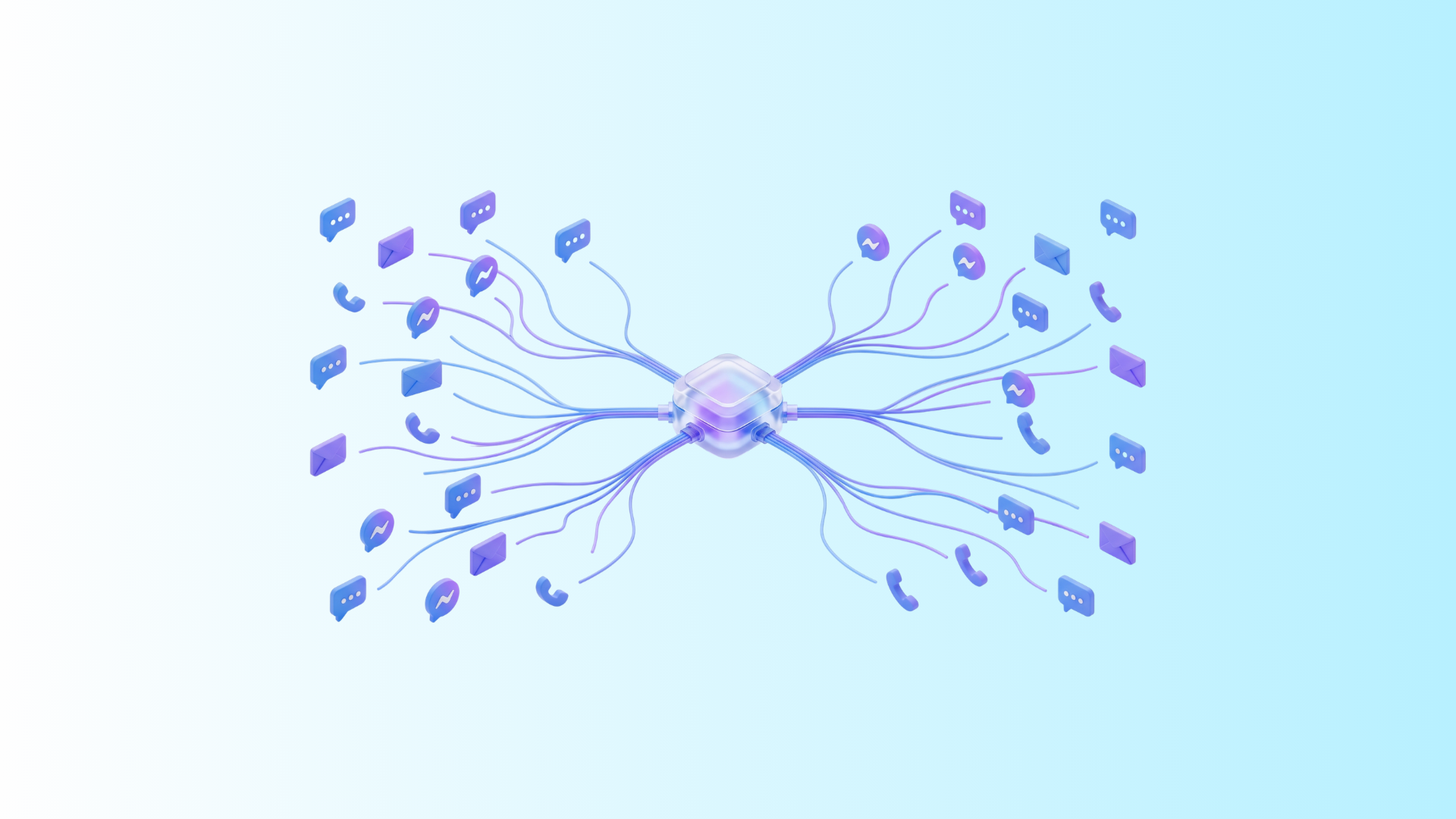
Imagine a typical Monday in the support department of an average e-commerce business. One tab is Telegram, the second is WhatsApp Business, the third is Instagram Direct, the fourth is email, and the fifth is the website’s live chat. The operator switches between them, struggles to keep up, and customers wait — then leave for competitors.
This is the reality for most companies that have grown organically, simply “adding a new channel” whenever customers asked for it.
The way out of this chaos is an omnichannel platform with built-in AI. But what does this mean in practice, how exactly does it reduce workload, and what pitfalls should you be aware of? Let’s explore.
What happens when support channels are disconnected
When support channels operate in isolation, a company pays for it three times: in money, time, and reputation. Agents spend up to 30% of their working time just switching between interfaces and searching for the context of previous conversations.
A customer who has already explained their issue in one channel is forced to repeat everything again in another — one of the most common reasons for dissatisfaction.
On top of that, each isolated channel becomes a separate quality control point. Managers can’t see the full picture: how many requests are currently open, where delays occur, or which agents are overloaded. Decisions are made blindly.
What is a unified omnichannel AI platform and how is it different from a chatbot
It’s important to distinguish between two concepts that are often confused. A chatbot is a standalone tool, usually tied to a single channel (for example, a bot in Telegram), that answers common questions based on predefined scenarios.
An omnichannel AI platform is a much broader system. It:
- brings all channels (Telegram, WhatsApp, Viber, Instagram, Facebook Messenger, web chat, email) into a single interface for agents
- stores a unified customer profile with the full interaction history across all channels
- uses artificial intelligence to automate part of requests, route complex cases, and suggest replies to agents
| Criteria | Traditional chatbot | Omnichannel AI platform |
|---|---|---|
| Number of channels | 1–2 | All channels in one place |
| Customer profile | None or per channel | Unified, cross-channel |
| Escalation to agent | Basic or none | Smart, with full context |
| Analytics | Basic bot metrics | End-to-end analytics |
| AI learning | Fixed scenarios | Learns from real conversations |
| Agent assistance | None | AI suggests responses |
Automatic resolution of common requests
Most support inquiries are repetitive: “Where is my order?”, “How do I return an item?”, “When will it be delivered?”, “I forgot my password.”
AI trained on real company conversations can resolve these requests without human involvement, immediately reducing a significant portion of the overall workload.
Smart routing
Not every request that reaches an agent should go to the most experienced specialist. AI identifies the topic of the inquiry, its level of complexity, and the customer’s emotional tone, and routes the conversation to the right agent immediately. This eliminates internal handoffs, which themselves increase resolution time and customer frustration.
AI suggestions for agents
When a request does reach a human, AI doesn’t leave the agent on their own. The system analyzes the customer’s message in real time and suggests relevant responses from the knowledge base or ready-made phrasing.
Agents no longer “write from scratch” — they edit and send. Response speed increases significantly.
Unified customer profile — the end of repeated questions
“What’s your order number?” — a question customers often hear multiple times within a single request, because each agent starts with an empty screen.
When the entire history is available in one place, this wasted time disappears. The average resolution time decreases, while NPS (Net Promoter Score) increases.
What implementation looks like: from chaos to system
Let’s walk through the implementation of an omnichannel AI platform:
- Audit of the current state: analyze all active channels, request volume, and top inquiry topics
- Channel integration: connect Telegram, WhatsApp Business API, Instagram, Viber, etc.
- Knowledge base creation: the most critical step. AI learns to respond like your best agents. This requires a structured FAQ, real conversation examples, and a corporate glossary
- Routing and escalation setup: define which requests AI handles and which go directly to humans. Configure SLAs, queues, and priorities
- Pilot and team training: launch in test mode on part of the traffic. Agents learn the new interface — usually within 1–3 days
- Continuous improvement: AI improves with new conversations. Regular review of “failed” responses increases automation quality week by week
Who is it for?
An omnichannel AI platform is not a one-size-fits-all solution. There are scenarios where it delivers maximum value — and cases where implementation may be premature.
| Scenario | Impact | Comment |
|---|---|---|
| E-commerce with >200 requests/day | Maximum | High share of repetitive inquiries, clear scenarios |
| SaaS / technical support | High | Removes first line, leaves complex cases to humans |
| Banking & finance | Medium / regulated | Requires strong compliance and data security |
| Healthcare / legal services | Limited | Most cases require human judgment |
| Small business <30 requests/day | Low | Implementation costs may not pay off |
How to measure success: key metrics to track
Launching the platform is only the beginning — you need clear metrics to understand if you’re moving in the right direction.
- Automation Rate – percentage of requests resolved by AI without human involvement. The higher it is, the lower the workload on your team
- FCR (First Contact Resolution) – whether the issue was resolved in the first interaction. Growth indicates customers receive complete answers immediately
- AHT (Average Handling Time) – how much time an agent spends per request. Reduction shows that AI suggestions and unified profiles are working
- CSAT (Customer Satisfaction) – post-interaction satisfaction score (e.g., 1–5 or 👍/👎). Growth indicates improved service quality
- Escalation Rate – percentage of requests passed from AI to humans. It should decrease, but never reach zero — complex cases require human handling
- Containment Rate – percentage of requests fully resolved by the chatbot without human involvement. Month-over-month growth shows AI learning and improving knowledge base quality
NovaTalks: the platform that makes it work
NovaTalks is an omnichannel customer support platform that brings all communication channels into a single interface. No customer is left unattended: all inquiries (from messengers, email, and website chat) are collected in one place for fast processing.
If a customer prefers not to communicate via chat, an agent can switch to a phone call or send an email in one click. The platform easily scales for any contact center size and adapts to business needs through custom development.
What’s included in the platform
- Chatbots – a built-in builder for creating multilingual bots for each channel. Bots operate 24/7 and seamlessly hand over conversations to live agents when needed
- AI tools – a real-time assistant that corrects mistakes, translates, adjusts tone, and summarizes conversations. Automated quality assessment analyzes 100% of interactions, while a manager manually can review at most 5%
- Reporting – customizable reports, agent performance metrics, and real-time service quality tracking
- NovaTalks Insights – text and speech analytics that automatically extracts key insights from conversations and turns large volumes of data into actionable improvements for the contact center
Every NovaTalks customer gets a dedicated account manager and access to a mobile app to manage communications from anywhere.
Conclusion
If your company supports customers across multiple channels and handles more than 50–100 repetitive inquiries daily, an omnichannel AI platform pays off.
Not by reducing your team, but by enabling the same team to handle more requests, more efficiently, and with less burnout.
The results are real — but they require proper implementation, a well-structured knowledge base, and a commitment to continuous improvement. A platform is not a one-time solution; it’s an ongoing process that delivers results for those who take it seriously.
FAQ
What is an omnichannel AI messaging platform in simple terms?
It’s a single place where all customer messages (Telegram, WhatsApp, Viber, Instagram, email, and website chat) are collected, and AI helps respond to them. Agents see one window instead of five tabs, while AI handles repetitive questions automatically.
Will AI replace my support agents?
No. AI takes over repetitive, routine inquiries and gives agents more time for complex, emotional, or нестандартні situations. Companies that implement such platforms typically don’t reduce their teams — they redistribute effort.
How can I be sure AI responds correctly and doesn’t mislead customers?
You need a quality control system: regular review of automated responses, confidence thresholds (below which AI does not respond independently), and an easy option for customers to switch to a human. A good platform allows you to track “failed” interactions and continuously improve the knowledge base.
How does NovaTalks reduce support workload?
NovaTalks brings all communication channels into a single interface. Agents see the full customer history regardless of the channel and don’t waste time switching between tabs.
Built-in chatbots handle repetitive requests 24/7, while the AI assistant supports agents in real time: suggesting replies, correcting mistakes, and summarizing conversations. Automated quality evaluation analyzes 100% of interactions, allowing managers to focus only on cases that truly require attention.